
By Thomas Welch
If you are budgeting for a new scoreboard, the honest answer to “how much does a scoreboard cost?” is that it depends on the project. Two schools can buy scoreboards for the same sport and end up with very different totals because of size, features, control options, installation conditions, and whether a video display is part of the plan. This guide walks through every factor that moves scoreboard cost up or down, so you can build a realistic budget before you request a quote.
Why Scoreboard Prices Vary So Much
A scoreboard is rarely an off-the-shelf purchase. Most school and park projects are configured to the venue: the sport, the viewing distance, the information fans need to see, how the board will be controlled, and how it will be mounted. Freight, site work, and local electrical requirements add another layer. That is why reputable manufacturers quote projects individually rather than publishing a single price.
The good news is that the cost drivers are predictable. Once you know which ones apply to your facility, you can make trade-offs with confidence.
1. Size and Digit Height
Size is the biggest single driver of scoreboard cost. A larger cabinet needs more material, more LEDs, larger digits, and a heavier support structure.
- Match size to viewing distance. Fans in the top row of the bleachers or the far end of the field need larger digits than fans courtside. Buying more size than your sightlines require adds cost without adding value.
- Outdoor boards come in a wide range of sizes. Fair-Play’s baseball and softball scoreboards, for example, are offered in widths from 7 feet to 36 feet, and multi-purpose scoreboards range from compact 2-foot and 4-foot portable units up to 24 feet.
- Indoor boards are usually smaller because viewers sit closer, which typically keeps indoor projects more compact.
2. Sport-Specific Features
Every piece of information on the board is another set of digits or indicators. Common features that affect cost include:
- Baseball and softball: line score (inning-by-inning runs), hits and errors, ball/strike/out, at-bat indicator, pitch count, and pitch speed.
- Football: quarter, down, yards to go, ball on, possession, and timeouts.
- Basketball: period, bonus, team fouls, player number and fouls, and integrated shot clocks.
- Multi-sport fields: changeable captions and two- or four-digit clocks so one board can serve football, soccer, field hockey, and more.
A basic scoreboard that shows time, score, and period will cost less than a full line score or a board with player statistics. List the information your coaches and fans actually use, then configure to that list.
3. Electronic Team Names and Captions
Electronic team names (ETNs) let you program home and guest names instead of using fixed panels, which is popular with schools that host tournaments. Fair-Play electronic team names use amber LEDs and are available in:
| Application | Character heights | Widths |
|---|---|---|
| Outdoor scoreboards | 11″, 14″, or 20″ | 32, 40, or 48 pixels |
| Indoor scoreboards | 5″ or 7″ | 32 or 48 pixels |
Larger characters and wider modules add cost. Rear-illuminated captions are another option that improves readability at night.
4. Control System: Wired or Wireless
How the operator controls the board affects both equipment and installation cost.
- Wired control uses a cable or signal run from the controller to the scoreboard. The controller may cost less, but long cable runs, conduit, and trenching on outdoor fields can add significant installation expense.
- Wireless control removes the cable run. Fair-Play’s MP-73 multi-sport wireless controller uses a 900 MHz radio with 16-channel selection and has been tested at 1,500 feet outdoors and 500 feet indoors. The battery-powered MP-80 interfaces wirelessly with any Fair-Play scoreboard and runs at least 30 hours on a full charge.
See our guide to wired vs. wireless controllers for a side-by-side comparison.
5. Adding an LED Video Display
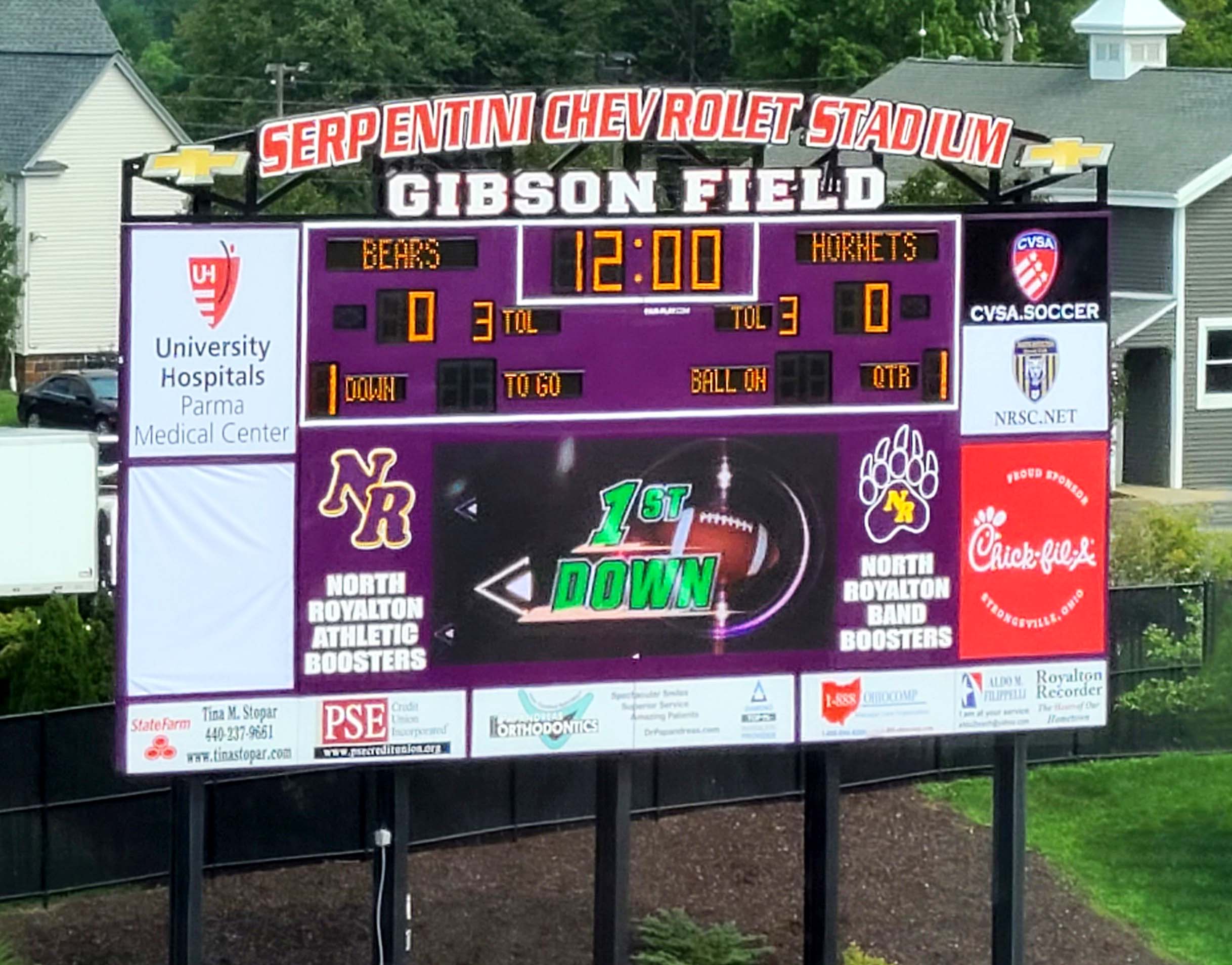
Pairing a scoreboard with a full-color LED video display is the largest optional upgrade, and it changes the budget conversation. Video displays are priced largely by size and pixel pitch (the distance between pixels). Smaller pitches deliver sharper images and cost more per square foot.
- Outdoor options from Fair-Play include 6mm, 10mm, and 16mm pitches. Our article on 10mm vs. 16mm outdoor LED displays explains how to choose.
- Indoor options include 1.9mm, 2.5mm, and 3.9mm displays for close viewing.
- Video also requires control software and someone to run it on game day.
Many schools offset video costs with sponsor revenue. See how in video scoreboard sponsorship, or compare formats in LED video scoreboard vs. traditional scoreboard.
6. Installation and Site Costs
Installation is often where budgets surprise people. Plan for:
- Structure: poles, beams, footings, and engineering for outdoor wind loads, or mounting hardware and structural review for indoor walls and ceilings.
- Equipment: crane or lift rental for outdoor installs.
- Electrical: a dedicated circuit near the board and, for wired systems, the signal run back to the press box or scorer’s table.
- Permits and site prep: local requirements vary by municipality and district.
- Freight: larger cabinets cost more to ship.
Ask your dealer for Fair-Play’s install drawings early. Each scoreboard model has faceview and installation drawings that help your contractor estimate structural and electrical work accurately.
7. Sponsor Panels and Branding
Sponsor panels and custom colors are a cost line, but they are also how many schools pay for their scoreboard. A single sponsor panel can generate recurring revenue for years. Factor sponsorship potential into your budget, not just the purchase price.
How Schools Pay for a New Scoreboard
- Sponsorships: local businesses fund static panels or digital ad rotations in exchange for visibility.
- Booster clubs and capital campaigns: common for stadium and gym upgrades.
- Phased upgrades: install the scoreboard now and add a video display, team names, or wireless control later.
- District capital budgets and grants: often tied to broader facility renovations.
Frequently Asked Questions
Why won’t manufacturers list a single scoreboard price?
Because the final cost depends on size, sport features, controls, installation conditions, and freight. A quote built for your venue is far more accurate than a catalog price.
Is a wireless scoreboard more expensive?
The wireless controller can cost more than a wired one, but wireless often saves money overall on outdoor fields by eliminating trenching and long cable runs.
Can I upgrade my scoreboard later?
Often, yes. Many projects add electronic team names, wireless control, or a video display in a later phase. Plan mounting and power with future upgrades in mind.
What information should I have ready for a quote?
Your sport(s), approximate viewing distance, indoor or outdoor location, desired features, preferred control method, and any sponsor or video plans.
Get an Accurate Quote for Your Facility
The fastest way to an accurate number is a conversation about your venue. Browse Fair-Play basketball, baseball and softball, football, and multi-purpose scoreboards, then contact a Fair-Play dealer to configure a scoreboard that fits your facility and your budget.