
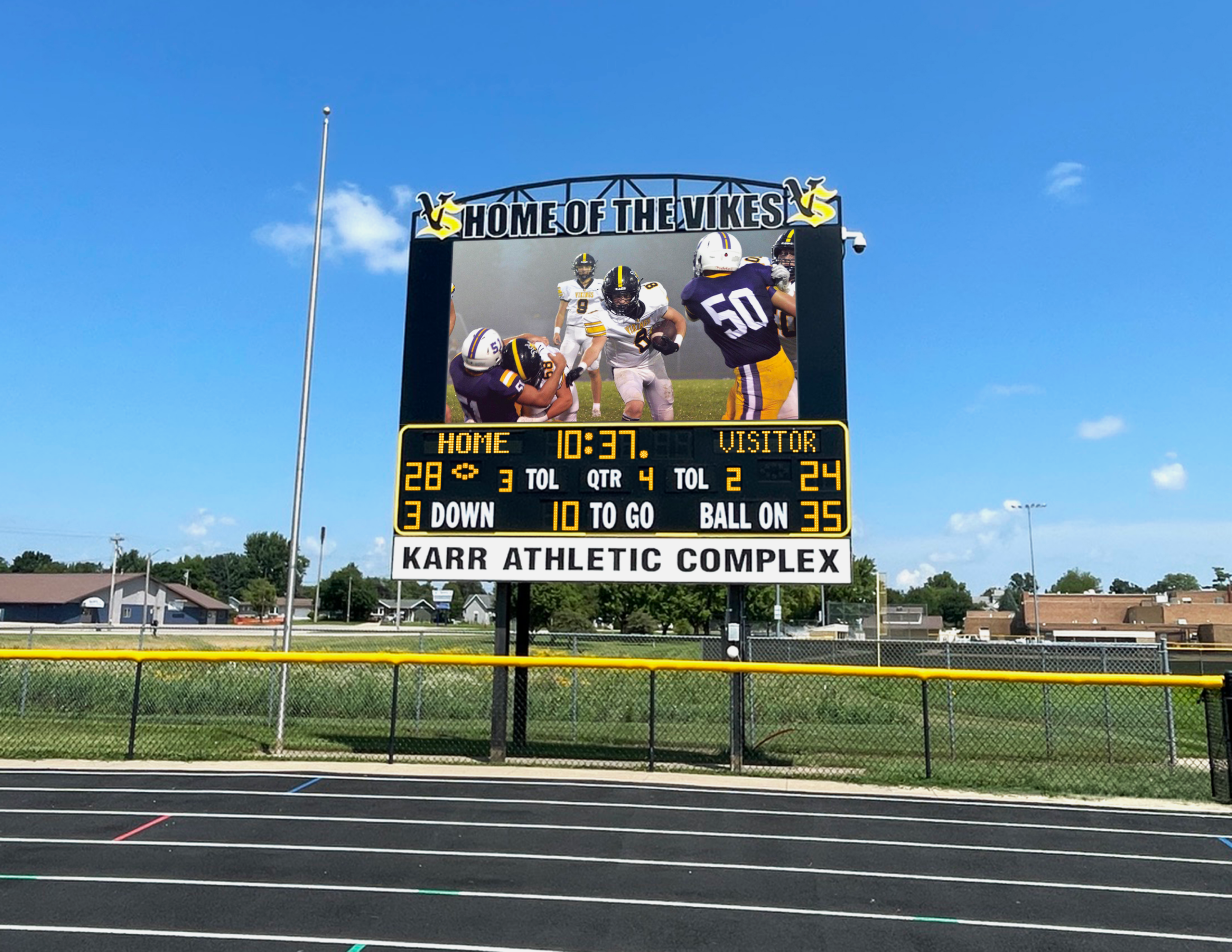
More schools are weighing an LED video scoreboard against a traditional scoreboard when it is time to upgrade. Video boards add replays, graphics, and sponsor content; traditional boards are simpler to run and built for long, low-maintenance service. Many facilities end up choosing a hybrid that combines both. This guide compares the options so you can decide which fits your school.
The Quick Answer
- Choose a traditional scoreboard if your priority is clear, reliable game information with minimal staffing and content needs.
- Choose an LED video scoreboard if you want replays, player introductions, live graphics, and digital sponsor inventory, and you have people to run it on game day.
- Choose a hybrid if you want a dependable scoreboard for game data plus a video display for fan engagement and sponsors. This is a common choice for high school stadiums and gyms.
What Is a Traditional Scoreboard?
A traditional scoreboard (often called a fixed-digit scoreboard) uses LED digits and indicators in fixed positions to show the clock, score, and sport-specific information. Options such as electronic team names, rear-illuminated captions, and sponsor panels customize the board, but the layout stays the same from game to game.
What Is an LED Video Scoreboard?
An LED video scoreboard is a full-color display made of LED pixels that can show anything: a digital scoreboard layout, live video, replays, animations, and sponsor ads. Its sharpness depends on pixel pitch, the distance between pixels. Fair-Play outdoor LED displays include 6mm, 10mm, and 16mm options, and indoor LED displays include 1.9mm, 2.5mm, and 3.9mm options.
What Is a Hybrid Display?
A hybrid pairs a traditional scoreboard with an integrated or adjacent LED video display. Game information stays on dedicated digits that are always readable, while the video display handles replays, graphics, and sponsor content. You can see many hybrid installations in Fair-Play’s project gallery.
Side-by-Side Comparison
| Factor | Traditional scoreboard | LED video scoreboard | Hybrid |
|---|---|---|---|
| Game information | Fixed digits, always visible | Shown in a digital layout | Fixed digits plus video |
| Fan engagement | Score and stats | Replays, graphics, intros, video | Both |
| Sponsor inventory | Static sponsor panels | Rotating digital ads | Static panels and digital ads |
| Game-day staffing | One scorekeeper | Scorekeeper plus a content operator | Scorekeeper, with video optional |
| Content needs | None | Graphics, videos, sponsor files | Optional |
| Upfront investment | Lowest | Highest | In between, depending on video size |
Revenue and Sponsorship
Sponsorship is the biggest reason schools move to video. Static sponsor panels sell one placement per panel. A video display can rotate many sponsors, run sponsored moments such as a “3-pointer” or “touchdown” graphic, and show proof of when each ad ran. Learn how in our guide to video scoreboard sponsorship.
Staffing and Game-Day Operations
A traditional scoreboard needs one operator with a controller such as the MP-70 or the wireless MP-80. A video board also needs someone to run content. Software such as Fair-Play Fusion lets student crews and volunteers run scoreboards, sponsor rotations, and video from one computer, with phone-based remotes for individual roles.
Choosing Pixel Pitch and Size
If you add video, pixel pitch is the key specification. Smaller pitches look sharper up close; larger pitches suit viewers farther away. For outdoor stadiums, our comparison of 10mm vs. 16mm outdoor LED displays explains the trade-offs. Indoors, fans sit closer, so smaller pitches such as 2.5mm or 3.9mm are common.
Decision Checklist
- Who will run it? If you do not have staff or students for video content, start with a traditional board or a hybrid.
- What is your sponsor market? Strong local sponsor interest makes video easier to fund.
- How far are your viewers? Viewing distance determines digit height and pixel pitch.
- Will you grow into video later? Plan structure and power for a future display even if you start with a traditional scoreboard.
- What is the total budget? Review what drives scoreboard cost before you request quotes.
Frequently Asked Questions
Can we add a video display to our existing scoreboard later?
Often, yes. Many schools start with a traditional scoreboard and add an LED video display in a later phase. Planning the structure and power for a future display makes this easier.
Is an LED video scoreboard harder to operate?
It requires more content and a second operator on game day, but software built for schools, such as Fair-Play Fusion, is designed for rotating student and volunteer crews.
Which lasts longer, video or traditional?
Both use LED technology. Traditional scoreboards have fewer components and simpler content needs, which keeps long-term operation straightforward. Ask your dealer about warranty and service for any display you consider.
Find the Right Display for Your School
Whether you choose a traditional scoreboard, an LED video scoreboard, or a hybrid, Fair-Play can configure a solution for your venue. Explore our outdoor LED displays, indoor LED displays, and sport-specific scoreboards, then contact a Fair-Play dealer to start planning.