
By Thomas Welch
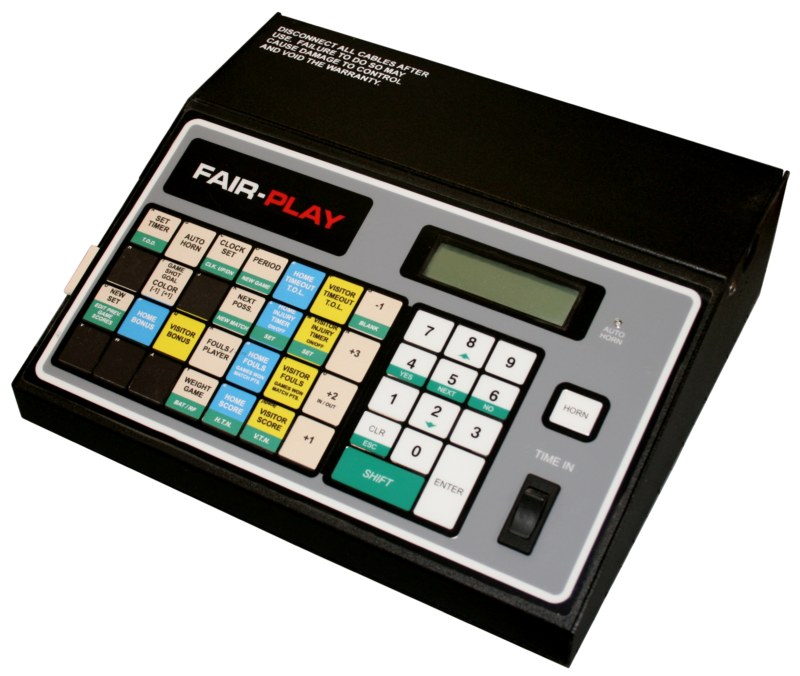
A scoreboard controller is the console an operator uses to run an electronic scoreboard. It starts and stops the game clock, changes the score, and updates every other display on the board, from the period and team fouls to timeouts left, possession, and player statistics. The scoreboard shows the information, but the controller is what tells it what to show.
What Does a Scoreboard Controller Do?
Every change you see on a scoreboard during a game starts with a button press on the controller. A typical controller handles:
- Game clock: start, stop, set, and reset the clock, including tenths of a second in the final minute on controllers with a jumping clock feature.
- Score: add or subtract points for home and visitor.
- Period, quarter, half, or inning: advance the game segment.
- Sport-specific indicators: team fouls, bonus, possession, timeouts left, penalties, balls, strikes, outs, down, and distance.
- Horn: sound the horn automatically at the end of a period or manually when needed.
- Accessories: on supported boards, run player statistics panels, electronic team names, and timers.
Most controllers are multi-sport. The operator chooses the sport, and the keypad functions change to match the scoreboard in use.
Types of Scoreboard Controllers
Wired scoreboard controllers
A wired controller connects to the scoreboard with a cable. Wired controls are a good fit for gyms and fields where the operator always sits in the same spot, such as at the scorer’s table or in a press box. The Fair-Play MP-70 is a wired multi-sport controller that stores up to six sport and scoreboard configurations, includes a two-line LCD display, and has a memory circuit that keeps game information if power is lost.
Wireless scoreboard controllers
A wireless controller sends commands to a receiver at the scoreboard by radio, so no control cable has to run from the operator to the board. The Fair-Play MP-73 uses a 900 MHz radio with 16-channel selection and frequency hopping to resist interference. It has been tested at a range of 1,500 feet outdoors and 500 feet indoors.
Battery-powered controllers
Battery-powered controllers let the operator move around without looking for an outlet. The Fair-Play MP-80 is wireless, comes preloaded with multiple sports, and charges by USB from a wall charger or computer. A full charge should last at least 30 hours, and it can work with any model of Fair-Play scoreboard.
Handheld controllers
Handheld remotes are small, single-hand controls for basic operation or a specific job. The HCW-MP-1 is a compact battery handheld with a rechargeable lithium-ion battery that works with the MP-73 and MP-80. Fair-Play also offers sport-specific handhelds, such as the HCW-PC-1 for pitch count and the HCW-TN-1 for tennis.
Statistics controllers and hand switches
Larger scoreboards often add a second control. The SP-70 Statistics Controller works alongside the MP-70 to run player statistics panels and lineup panels. A hand switch is a separate start/stop switch, often used by a timer at the table so the clock can be stopped the instant an official signals.
Fair-Play Scoreboard Controllers at a Glance
| Controller | Connection | Power | Best for |
|---|---|---|---|
| MP-70 | Wired | 120V | Fixed operator location; up to six stored configurations |
| MP-73 | Wireless, 900 MHz | 120V, optional battery | Long distances; tested 1,500 ft outdoors / 500 ft indoors |
| MP-80 | Wireless, 900 MHz | Battery, USB charging | Portable operation; 30+ hours per charge |
| HCW-MP-1 | Wireless handheld | Rechargeable lithium-ion | Simple handheld control with the MP-73 or MP-80 |
| SP-70 | Wired | 120V, optional battery | Player statistics panels, paired with the MP-70 |
Wired or Wireless: Which Is Better?
Neither is better for every school. Wired controllers are simple and need no radio setup, but they tie the operator to the cable location. Wireless controllers make it easy to run the board from anywhere in the gym or stadium and remove the need for long control cable runs, which can lower installation work at outdoor fields.
When Should You Replace a Scoreboard Controller?
Consider a new controller when:
- Buttons stick, the display is hard to read, or the controller resets during games.
- You want to move the operator to a new spot, such as from a press box to the sideline.
- You added a scoreboard, stat panels, or a sport, and the current controller cannot run them.
- Running a control cable to a new outdoor scoreboard would be costly or difficult.
- You want a battery-powered or handheld option for practices and events.
How to Choose a Scoreboard Controller
- Where will the operator sit? A fixed table or press box works well with wired control. A changing or distant location favors wireless.
- How far is the scoreboard? Check the distance and any walls or structures between the operator and the board.
- What sports will you run? Make sure the controller covers every sport and configuration you use.
- What else is on the board? Stat panels, team names, and timers may need specific controls.
- Who will run it? Volunteers and student operators benefit from a clear display and simple key layout.
Scoreboard Controller FAQs
What is a scoreboard controller called?
It may be called a scoreboard console, scoreboard control, keypad, or scoreboard remote. They all describe the device used to operate the board.
Can one controller run more than one sport?
Yes. Most modern controllers are multi-sport. The MP-70, for example, stores up to six sport and scoreboard configurations.
How far can a wireless scoreboard controller reach?
It depends on the model and the venue. The Fair-Play MP-73 has been tested at 1,500 feet outdoors and 500 feet indoors.
Can I upgrade my controller without replacing my scoreboard?
Often, yes. Fair-Play can tell you which current controllers are compatible with your scoreboard model and what, if anything, needs to be added at the board.
Find the Right Controller for Your Scoreboard
Fair-Play offers wired, wireless, and handheld scoreboard controls for every sport. Contact Fair-Play to match a controller to your scoreboard and venue.