
By Thomas Welch
A baseball scoreboard is one of the biggest investments a school, college, or park makes in its field. The right board shows fans, players, and umpires exactly what they need to see, holds up season after season, and fits your field’s layout and budget. This buying guide covers the types of baseball scoreboards, sizing, must-have features, controls, and installation, so you can choose with confidence.
The Quick Answer
- Youth and recreation fields usually need a basic scoreboard with runs, inning, and ball/strike/out.
- High school varsity fields commonly choose a line score with hits and errors, plus electronic team names, sponsor panels, and wireless control from the press box.
- College and high-profile fields often add pitch speed, pitch count, and an LED video display for replays and sponsors.
Types of Baseball Scoreboards
Basic baseball scoreboards
A basic board shows home and guest runs, inning, and ball/strike/out. It is the simplest and most compact option, well suited to youth leagues, practice fields, and softball complexes with several diamonds.
Line score scoreboards
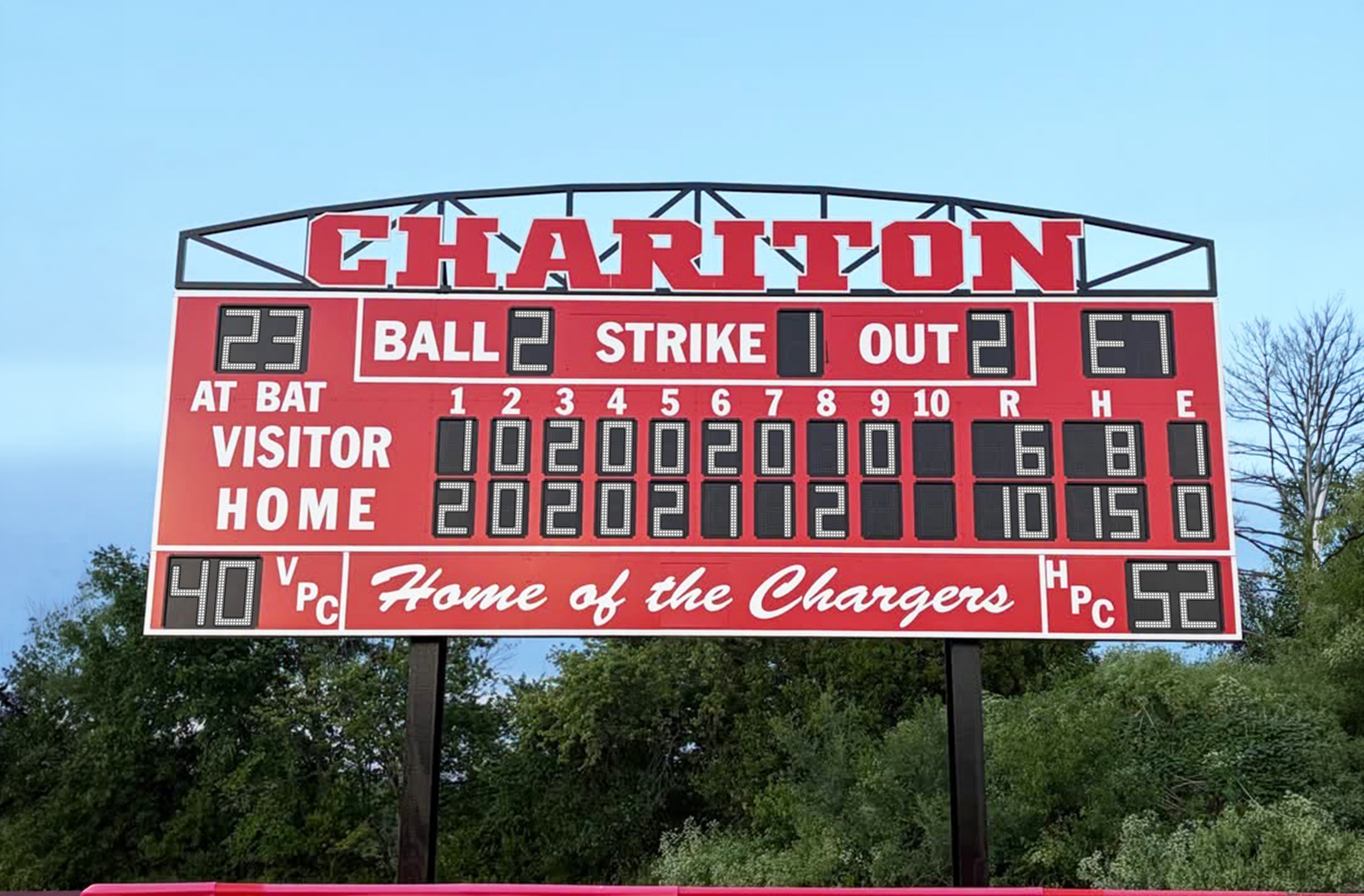
A line score displays runs for each inning, plus total runs, hits, and errors. It is the classic high school and college baseball scoreboard, because fans can follow the whole game at a glance.
Scoreboards with pitch count and pitch speed
Pitch-count rules have made pitch tracking a priority for many programs. Fair-Play’s MP-80 controller supports extended baseball with pitch count, and the HCW-PC-1 wireless handheld lets a separate operator track pitches. Fair-Play also offers a pitch speed indicator and pitch timers as accessories.
Hybrid scoreboards with LED video
A hybrid pairs a line score with an LED video display for replays, player introductions, and digital sponsor ads. Fair-Play offers 6mm and 10mm outdoor LED solutions for baseball fields. See LED video scoreboard vs. traditional scoreboard to compare.
Choosing the Right Size
Fair-Play baseball and softball scoreboards are offered in widths of 7, 9, 14, 16, 18, 20, 26, 27, 28, and 36 feet. To choose:
- Measure the viewing distance from the farthest seats and from the dugouts to the scoreboard location.
- Decide what information you need. A full line score needs a wider board than a basic scoreboard.
- Leave room for sponsors and branding. Sponsor panels and team logos add width and height.
- Check the site. Outfield placement, fences, and sightlines affect how large a board can practically be.
Must-Have Features for Baseball
| Feature | What it does |
|---|---|
| Line score | Shows runs by inning plus total runs, hits, and errors |
| Ball/strike/out | Core count information for fans and players |
| At-bat indicator | Shows which team is batting |
| Electronic team names | Programmable names; outdoor characters in 11″, 14″, or 20″ heights |
| Pitch count | Supports pitch-count rules and player safety |
| Pitch speed | Adds fan interest; available as an accessory |
| Rear-illuminated captions | Improves caption readability at night |
| Sponsor panels | Generates revenue to help fund the scoreboard |
Controls: Press Box, Dugout, or Both
Baseball press boxes are often far from the outfield scoreboard, which makes wireless control popular. The MP-73 wireless controller uses a 900 MHz radio with 16-channel selection and has been tested at 1,500 feet outdoors. The battery-powered MP-80 lasts at least 30 hours per charge and can work alongside a wireless pitch-count handheld. Wired controllers such as the MP-70 remain an option where cable is already in place. Read more in wired vs. wireless scoreboard controllers.
Baseball and Softball on One Scoreboard
Many schools and parks host both baseball and softball. Fair-Play baseball and softball scoreboards serve both sports, and multi-sport controllers store several configurations, so the same board can handle both seasons.
Installation and Budget Planning
Outdoor baseball scoreboards need poles or a support structure, footings engineered for wind loads, power at the board, and either a signal cable or a wireless receiver. Each Fair-Play scoreboard model has faceview and installation drawings, which help your contractor plan structural and electrical work. Because every field is different, cost depends on size, features, controls, and installation conditions. Our guide to how much a scoreboard costs explains each factor.
Frequently Asked Questions
What size baseball scoreboard do I need?
It depends on viewing distance and the information you want to display. Basic scoreboards suit smaller fields; line scores and sponsor panels call for wider boards. Fair-Play baseball scoreboards range from 7 to 36 feet wide.
Can one scoreboard serve baseball and softball?
Yes. Fair-Play baseball and softball scoreboards are designed for both sports.
Can the scoreboard track pitch count?
Yes. The MP-80 controller supports extended baseball with pitch count, and the HCW-PC-1 wireless handheld lets a separate operator track pitches.
Should I control the scoreboard from the press box or the dugout?
Wireless control lets you do either. Many programs keep the main controller in the press box and use a wireless handheld for pitch count.
Choose the Right Baseball Scoreboard
Browse Fair-Play baseball and softball scoreboards by size, explore controllers and accessories, and contact a Fair-Play dealer to configure a scoreboard for your field.