
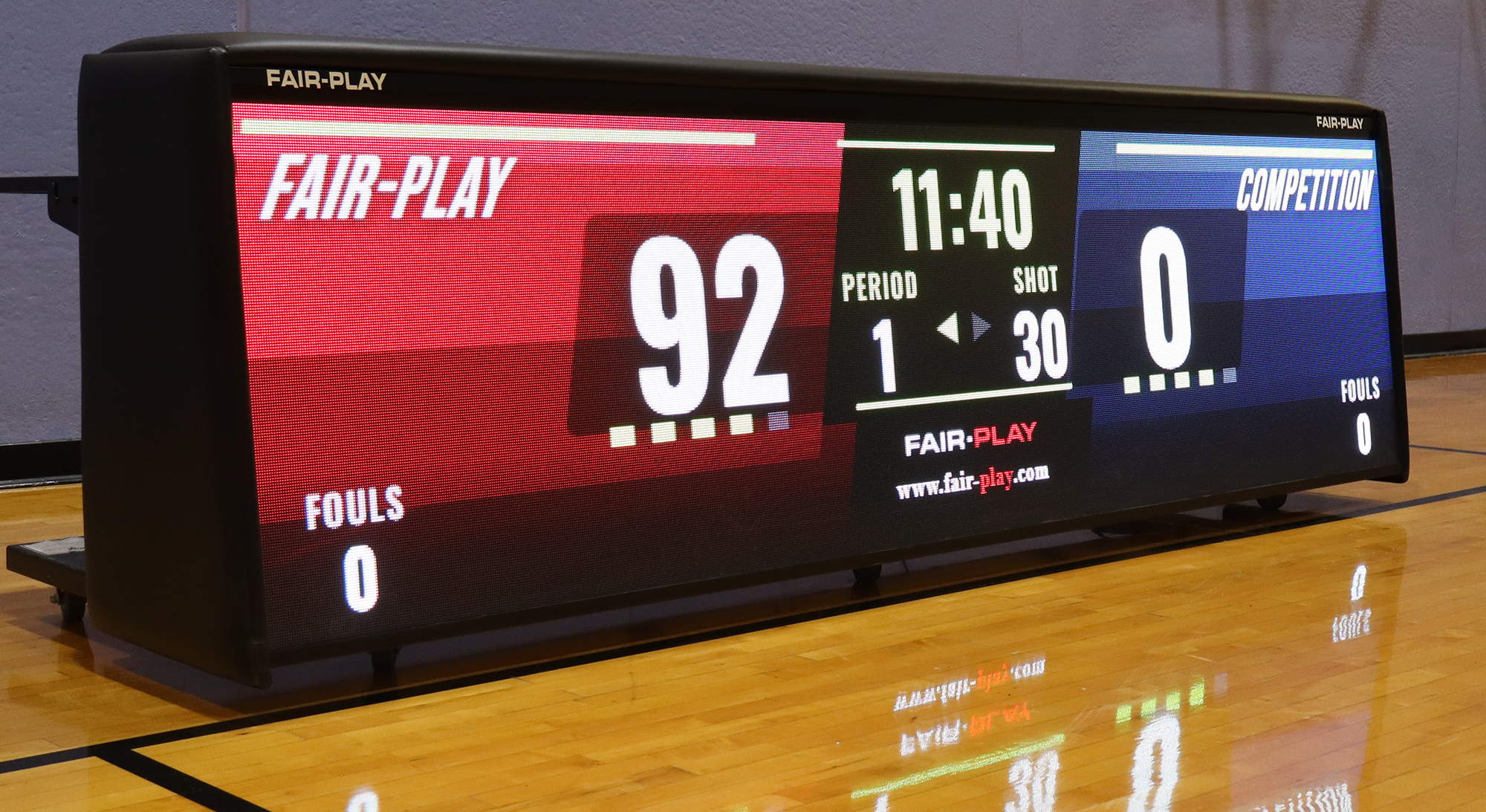
When athletic directors research how to choose a scorer’s table, they need to look beyond appearance. The right table should accommodate game-day staff, fit the available court space, integrate with venue technology, and withstand regular use.
This scorer’s table buying guide explains how to compare the factors that matter most for high schools, colleges, recreation centers, and professional venues. Fair-Play offers scorer’s tables designed to support reliable operations and a more engaging game-day experience.
What Type of Scorer’s Table Is Right for Your Facility?
A basketball scorer’s table may use printed graphics, rear illumination, or a full-color LED display. Traditional static tables support school branding and sponsor recognition, while rear-illuminated tables add visibility without requiring a complete digital presentation system. LED scorer’s tables can show advertisements, animations, team graphics, and other dynamic content.
Athletic directors should also compare mobile and fixed configurations. Tables with casters can be moved for practices, physical education classes, and other events. Bleacher-mounted or permanent installations may suit facilities with a dedicated game-day layout. Your venue, event schedule, storage needs, and presentation goals should guide the choice.
What Size Scorer’s Table Does Your Facility Need?
Start by measuring the available sideline area, including clearance for team benches, substitutions, and movement around the court. Scorer’s table dimensions should accommodate the scorekeeper, clock operator, announcer, statistician, media staff, and any computers or control equipment they use.
Fair-Play offers 8-foot, 10-foot, and 16-foot models, and multiple LED units can be connected for a longer display. Consider the complete footprint, including end padding, rather than relying only on the nominal table length. Confirm that the table can also pass through doors and fit in its designated storage area.
Key Features to Evaluate in a Digital Scorer’s Table
A digital table should be evaluated as both display technology and functional courtside furniture. Display performance, operator controls, safety, construction, and compatibility all affect its long-term value.
LED Display Quality and Digital Scoreboard Integration
Pixel pitch measures the distance between individual LED pixels. A smaller pixel pitch generally provides sharper text and graphics at close viewing distances, which can be valuable for courtside spectators and video coverage.
Buyers should also compare brightness, resolution, refresh rate, color quality, and viewing angles. High refresh rates help graphics appear smoother on cameras and livestreams. Confirm that the table can work with your digital scoreboard, venue LED displays, control system, and required video or data formats.
Software, Controls, and Content Management
Software should be intuitive enough for staff members and volunteers to operate confidently. Ask how users load advertisements, organize playlists, change graphics, and trigger content during key moments such as introductions, timeouts, and three-point shots.
Determine whether one operator can coordinate the scorer’s table with other displays. Facilities selling digital advertisements should also ask about scheduling and playback-reporting capabilities. Training, software updates, and accessible technical support are important parts of the overall system.
Safety, Mobility, and Court-Side Construction
Scorer tables operate close to fast-moving athletes, so protective construction is essential. Look for padded tops and ends, impact-resistant display protection, secure equipment compartments, and durable aluminum or steel framing.
Mobility features should include sturdy casters, balanced weight distribution, and dependable locking mechanisms. Folding tabletops, internal cable trays, and protected rack space can simplify transportation and storage while reducing clutter during events.
Installation, Power, and Infrastructure Considerations
Confirm electrical, data, and control requirements before ordering. A site assessment can identify the required outlets, cable routes, network connections, structural considerations, and integration work.
Athletic directors should also plan how the table will be delivered, assembled, tested, and stored. Installation timelines vary according to configuration and site conditions, so request a schedule that covers delivery, setup, system testing, staff training, and final approval.
Why the Right Scorer’s Table Matters for the Game-Day Experience
A scorer’s table is a working area for officials and game personnel, but a digital model also becomes part of the venue presentation. It can show real-time game information, team colors, player graphics, announcements, animations, and crowd prompts.
Dynamic content keeps fans informed during play and engaged during breaks. A clear, vibrant LED display can also give a school gym or arena a more polished appearance while strengthening school identity and community pride.
How Scorer’s Tables Create Sponsorship Opportunities
Because the table sits near the center of the action, it offers valuable visibility for local business advertisements. Digital scorer’s tables can rotate several sponsor messages instead of limiting the athletic program to one printed panel.
Schools may offer season-long packages, individual event placements, sport-specific campaigns, or premium rotations during high-attention moments. Actual revenue depends on attendance, event frequency, sponsor demand, package pricing, and the amount of advertising inventory available.
Budgeting and Calculating Potential ROI
The purchase price is only one part of the budget. Athletic directors should account for delivery, installation, electrical work, software, training, maintenance, and possible content-development costs.
A realistic ROI projection should compare total project cost with conservative sponsorship estimates over several seasons. Programs may combine sponsor commitments with booster-club fundraising, capital budgets, or other approved funding sources. Any financing or grant availability should be verified before it is included in the purchasing plan.
Operations, Training, and Long-Term Support
Ask each vendor how operators are trained and what documentation is provided. Quick-reference guides can help volunteers handle common tasks without interrupting the game.
Compare warranty terms, replacement-parts availability, maintenance expectations, and response procedures for game-day problems. Customer references from similar athletic programs can also reveal how the equipment and support perform after installation.
Decision Checklist for Athletic Directors
Before requesting a final quote, confirm that:
- The table type supports your operational and presentation goals.
- Its dimensions accommodate personnel, equipment, court space, and storage.
- The LED display provides suitable clarity, brightness, and viewing angles.
- Software and controls match the experience level of your operators.
- Safety, mobility, installation, warranty, and support requirements are documented.
A complete comparison helps purchasing teams evaluate long-term fit rather than choosing solely by upfront price.
Why Choose Fair-Play and What to Do Next
Fair-Play has provided scoring and display solutions since 1934. Its scorer’s tables combine courtside protection, modular configurations, display technology, and practical features such as casters, cable management, folding surfaces, and equipment space.
Athletic directors can use Fair-Play’s online tool to design a scorer’s table with their preferred model, padding, panels, and artwork. An authorized Fair-Play dealer can then review the venue, recommend a configuration, prepare a formal quote, and coordinate installation and long-term support.